ST-03 · SPEC
What a GoHighLevel AI Receptionist Really Costs
A GoHighLevel AI receptionist is a one-off build that then runs on metered minutes. What the build costs, the usage fee nobody quotes, and the front desk it stands in for.
A plumber we built for switched on his AI receptionist on a Monday and called us on the Friday about the bill. The receptionist was fine. It answered every call, booked the easy ones, took messages on the hard ones, and the phone stopped going to voicemail at 6pm. What rattled him was a line on his HighLevel invoice he had not quoted his client for, and had not quoted himself for either. The agent had been chatting. Every spoken second was metered, the voice he had picked was the expensive one, and the thing talked to callers for four minutes when ninety seconds would have booked them.
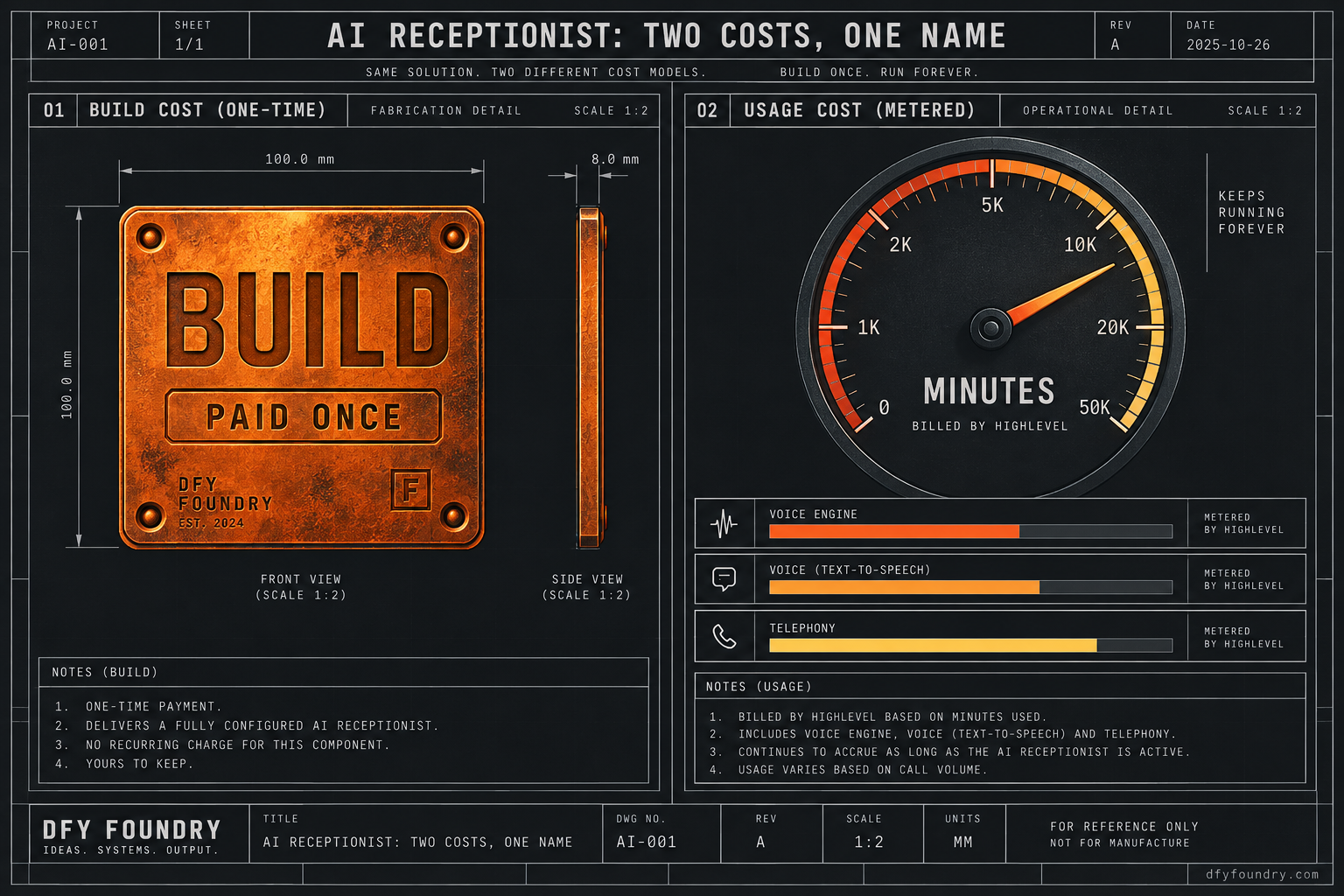
The build came out of the mould right. The cost came out wrong, because he had priced a receptionist like a thing you buy once and forgotten it runs on a meter. That is the split nobody draws clearly, so here it is. A GoHighLevel AI receptionist is two costs wearing one name: a build you pay for once, and a stream of minutes HighLevel bills you forever. This is what each half costs in 2026, how the two fit together, and the arithmetic that tells you whether the whole thing is cheaper than the front desk it stands in for.
What you are actually buying
Say “AI receptionist” to an agency owner and they picture a monthly subscription, like a seat in a tool. That picture is wrong in a way that costs money. Inside GoHighLevel the receptionist is not a seat. It is a voice agent you configure once and then feed with metered usage, and the two parts are priced on completely different clocks.
The build is the part you own. Somebody writes the script, wires it to a real calendar, sets the rules for which calls get handed to a human, and tests it until it stops embarrassing you. That work happens once. When it is done, it is done, and the agent will run for a year on the same configuration.
The minutes are the part you rent, and you rent them by the second. Every call the agent handles burns voice-engine time, text-to-speech time for the voice you chose, a few language-model tokens to work out what the caller meant, and telephony time for the phone line itself. None of that is in the build price. All of it lands on the HighLevel bill, every month, for as long as the phone rings.
The call path, and where the meter is running
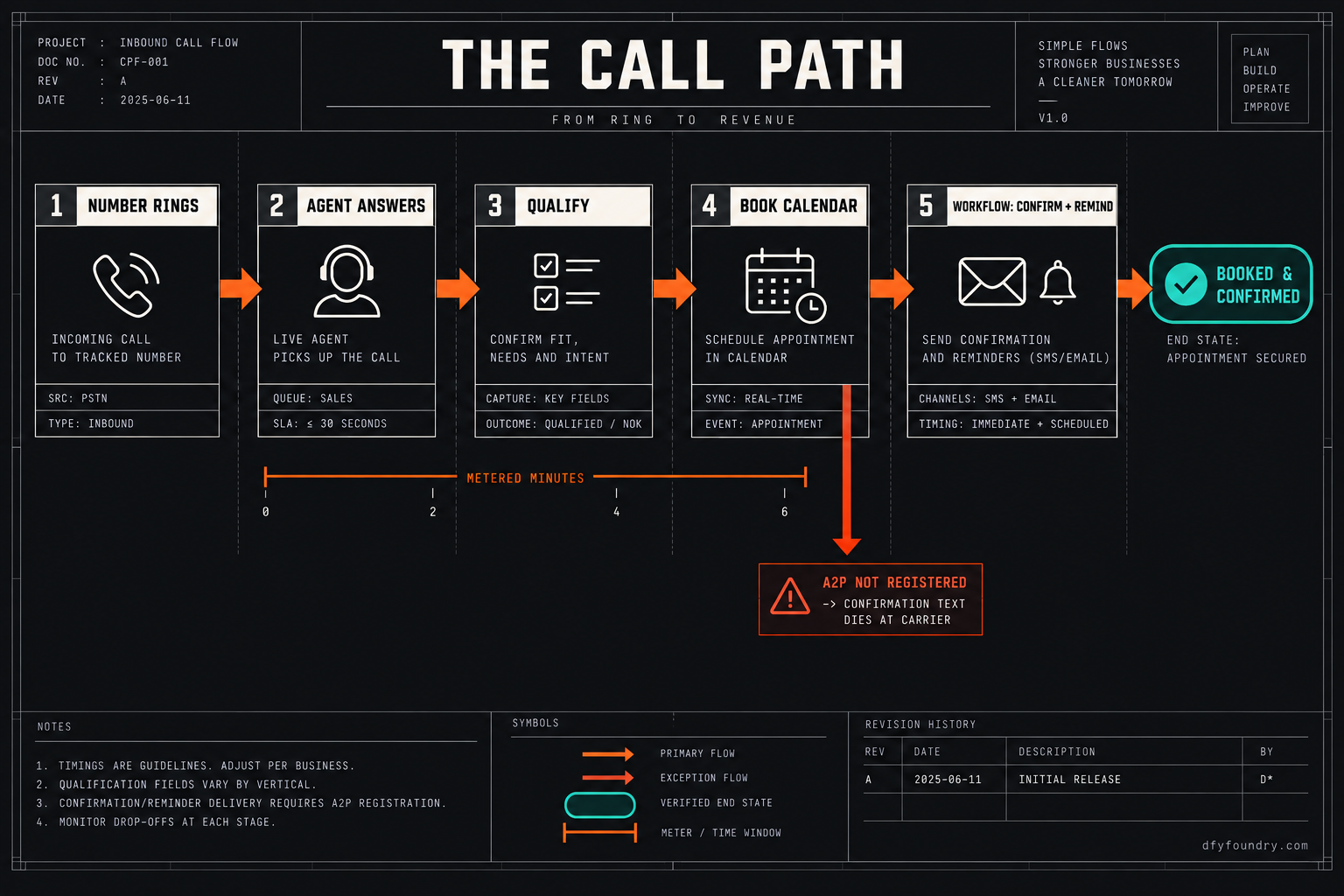
Here is a routine call, from ring to booked, so you can see which steps cost what.
A customer calls the client’s business number. That number lives in GoHighLevel’s phone system, and the moment the agent picks up, the telephony meter starts. The voice agent greets them in the script you wrote and listens. Working out what the caller wants is a language-model step, billed in tokens. The agent asks its qualification questions in the order you set, each answer spoken back in the voice you chose, and every one of those spoken seconds is text-to-speech time on the meter.
When the caller wants an appointment, the agent reads real availability off the calendar you wired, offers times, and books the slot. That booking fires a workflow, and the workflow sends the confirmation text and sets the reminder cadence that is doing the real work on no-shows later. If the call is one the agent was not built to handle, a pricing argument, a complaint, a job outside scope, it takes the details and hands off to a person rather than guessing. When it cannot connect at all, it drops to a smart voicemail with a booking link so the lead is not simply lost.
Receptionist and chatbot are not the same line item
GoHighLevel ships two different agents, and people conflate them because the bill folds them together. The AI Receptionist is voice: it answers the phone. The AI Chatbot is text: it handles the web chat and the inbound SMS. Both come inside a build, both are useful, and they are billed on different meters. Voice is the expensive one, because speech costs more to generate than text and the telephony line costs on top. A client who is drowning in web enquiries and a client whose phone never stops are buying different things, and pricing them the same is the first way the number goes wrong.
Where the build comes out of the mould wrong
The receptionist is not hard to stand up. GoHighLevel will let you switch one on in an afternoon. The trouble is that the quick version fails in expensive, quiet ways, and every one of them shows up as either a bill you did not expect or a lead you did not catch. Here are the five we see most.
The minutes bill nobody quoted
This is the plumber’s problem, and it is the most common. The agent works, so nobody looks at the usage line until it is large. Two things drive it up. The first is the voice. GoHighLevel lets you pick the voice the agent speaks in, and the premium voices cost several times what the standard ones do per minute. A client who will never notice the difference between a good standard voice and a premium one is paying a premium-voice meter for no reason. The second is call length. An agent with no instinct for brevity and no cap will happily spend four minutes where ninety seconds would book the slot, and at a per-minute meter that is not a rounding error across a few hundred calls a month.
What you see is a receptionist that answers every call. What is wrong is that it is answering them in the most expensive way available. The fix is to estimate the monthly minutes from the client’s real call volume before you switch anything on, pick a voice that fits the budget rather than the demo, cap the call length, and script the agent to reach a booking in the fewest turns rather than to chat.
It answers, but it books into the wrong calendar
A voice agent booking into a fictional calendar is worse than voicemail, because voicemail does not promise the customer a slot that nobody is holding. The common version of this is a timezone mismatch: the calendar is set to one zone, the agent reads availability in another, and it cheerfully books a 9am that is really a 6am. The other version is availability that was never wired to anything real, so the agent offers times the business cannot actually keep.
What you see is an agent that confirms bookings. What is wrong is that the bookings are landing in the wrong place or at the wrong hour, and the first person to find out is the customer standing at a locked door. The fix is to wire the agent to the sub-account’s real calendar, with real durations, real buffers and the correct zone, and to place test calls that book an actual slot and check where it landed. This is exactly the work the free installation window exists for, and it is the single step most self-built receptionists skip.
The confirmation text dies at the carrier
The booking is only half the job. The part that moves the no-show number is the confirmation and the reminder that go out after, and those are text messages. If the sub-account’s number was never registered for A2P 10DLC, the agent will book the appointment and the confirmation text will die silently at the carrier. No error on your screen, no text on the customer’s phone, and the reminder that was supposed to be chasing the 70% no-show recovery target never sends.
What you see is a receptionist booking appointments all day. What is wrong is that every downstream text is being filtered, so the reminders that justify the whole build are not arriving. The fix is A2P 10DLC registration and setup, with the opt-in wording checked before it is filed, which is one of the things the free installation hours cover. We wrote the full version of this failure in why a GoHighLevel snapshot will not send SMS or email, because it is the same carrier wall whether the message comes from a workflow or from an agent.
No handoff, so it improvises on the calls that matter most
A voice agent that guesses about pricing or scope creates a problem somebody has to unpick later. The high-value calls are often the exact ones the agent was not scripted for: the custom quote, the complaint, the job that is bigger than anything in the script. An agent with no escalation path will try to handle them anyway, invent an answer, and either lose the caller or commit the business to something it cannot do.
What you see is an agent handling every call on its own. What is wrong is that handling every call is not the goal, catching every lead is, and the hardest calls are the ones a person should be taking. The fix is a transfer and escalation rule for the calls that need a human, so the agent takes the details and hands off rather than improvising. The measure of a good voice build is not how much it handles. It is how cleanly it gets out of the way when it should.
The stock script that sounds like a demo
The last one is tone. A receptionist running a generic script quotes the wrong hours, mispronounces the trade, lists services the business does not offer, and sounds exactly like the demo video every other agency saw. Customers can tell, and a receptionist that sounds like a robot reading a brochure is a receptionist people hang up on.
What you see is a configured agent. What is wrong is that it is configured for a generic business, not the one whose phone it is answering. The fix is a script written for the trade and the way that trade’s customers actually talk, then tuned against real calls. Our Voice AI Agent Build places forty live test calls across every path, including the awkward ones, before the agent answers one of yours, and reviews the transcripts afterwards. That is the difference between a receptionist and a recording.
The numbers
Now the arithmetic, with every assumption on the table so you can put your own in. The build is one price. The minutes are another. What it replaces is a third, and that is the one that makes the case.
The build first. The AI Receptionist ships inside every snapshot build, and a snapshot in our catalogue runs $920 to $2,280, paid once, with installation free. The standalone Voice AI Agent Build is from $1,600 as a one-off, built in six days, for an account that already has calendars in it or needs the deeper tuning pass. Either way it is a build you pay for once and own.
The minutes next. HighLevel bills the AI usage to the sub-account, on top of the build and on top of the platform plan. The AI Employee add-on is listed at around $50 a month per location for the Growth tier, which includes roughly 100 voice minutes and a thousand Conversation AI responses, and around $97 a month per location for the Unlimited tier under a fair-use policy, per third-party pricing trackers confirmed via search snippet this run rather than fetched from HighLevel directly. On pay-per-use, the voice meter runs roughly $0.06 to $0.21 a minute depending on the voice you choose, before language-model tokens and telephony, according to one 2026 cost breakdown, with the phone line itself around $0.012 a minute inbound on top per another. Those rates vary and the sources disagree at the edges, so treat them as a range and check HighLevel’s current terms before you quote a client.
Now a worked month, so the shape is concrete. Assume a trade business, a dental clinic or an HVAC company, taking 150 inbound calls a month. Say the agent handles 120 of them, the routine bookings and questions, and that each runs 2 minutes on average. That is 240 voice minutes. At a mid-range voice near $0.15 a minute plus telephony near $0.015 a minute, call it $0.165, the usage lands around $40 a month. On the Unlimited AI Employee plan at about $97 a month those same minutes sit inside the plan. So the metered cost of this receptionist is somewhere between $40 and $97 a month, on top of a build paid once. Change the call volume or the average length and the number moves; the method does not.
Against that, the thing it stands in for. A human answering service, priced across the 2026 guides, runs roughly $220 to $300 a month for a small bundle of minutes, with overage billed at anywhere from $1.50 to over $5 a minute once you pass it. One guide puts Ruby near $250 a month for 50 minutes and PATLive near $219 for 75, both snippet-confirmed and inconsistent between sources, so read them as a band, not a quote. Push 240 minutes through a 50-minute bundle at a few dollars a minute of overage and the monthly bill runs past several hundred dollars, every month, forever. A full-time front-desk hire is the other comparison: the Bureau of Labor Statistics put the median receptionist wage at $17.90 an hour in May 2024, which is roughly $37,000 a year loaded, and that person does not work nights or weekends.
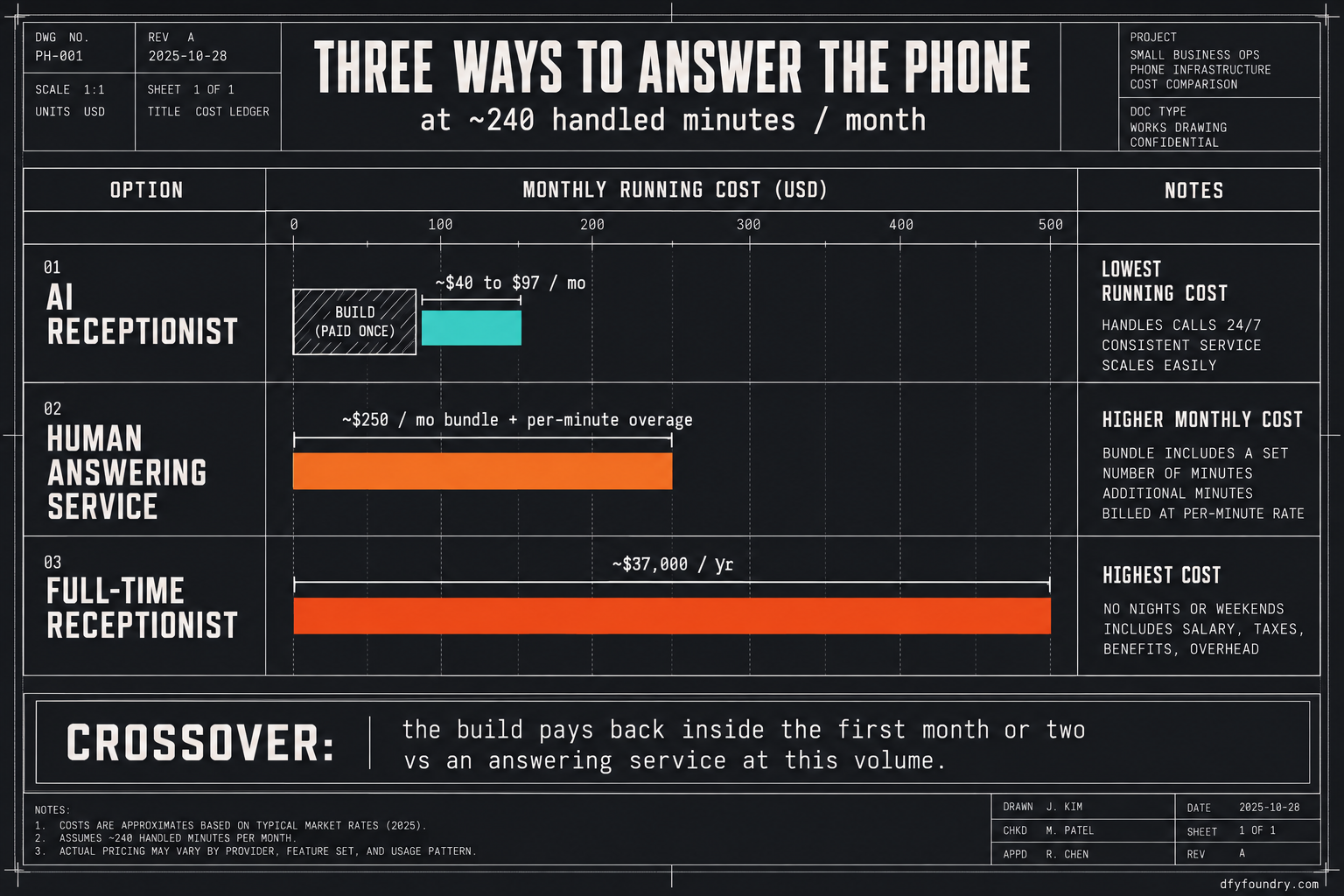
The read is not that the AI receptionist is free. It is that at ordinary small-business call volume, a build paid once plus tens of dollars of metered minutes a month sits well under an answering service billing hundreds a month forever, and the build pays itself back inside the first month or two. At very high volume, or where the calls genuinely need a trained human every time, the arithmetic tightens and a person or a hybrid can win. Run your client’s real minutes before you quote. The target the reminders are tuned to, the 70% no-show recovery, is a target we build toward, not a measured result from a named client, and it only holds if the texts actually send, which is why the A2P step above is not optional.
The objections, including the one against us
“An AI cannot replace my receptionist.” Correct, and anyone selling it as a replacement is setting up a refund. A person reads a room, handles the angry caller, and does the ten jobs that are not answering the phone. The AI receptionist is not for those. It is for the calls a person was never going to catch: the 6pm enquiry, the Saturday booking, the third caller while the first two are on hold. It books the routine ones, it texts the confirmation, and it hands off the rest. It is coverage for the leads you are currently sending to voicemail, not a layoff notice.
“The per-minute meter makes it more expensive than a human over time.” It can, at the top of the volume range, and that is the honest crossover. A business taking thousands of long, complex calls a month will spend real money on minutes, and at that point a dedicated person or a hybrid deserves a serious look. But most small-business phones do not run at that volume, and at a few hundred routine calls a month the meter is tens of dollars, not hundreds. The mistake is assuming the meter scales like a human salary. It scales like usage, which for most trades is modest. Put your real numbers in the arithmetic above and see where you land before you decide.
“Why pay you $1,600 when HighLevel has Voice AI built in and I can set it up myself?” You can, and if you have the hours and you know the trade, you should. The feature is in the platform and switching on a basic agent is genuinely an afternoon’s work. What the fee buys is the afternoon you do not spend, plus the four failure modes above that an afternoon does not fix: the script written for the trade so it does not sound like a demo, the calendar wired to the right zone so it does not book a 6am, the A2P registration so the confirmation text actually sends, the handoff rule so it does not improvise a price, and the forty test calls that find all of this before a customer does. If a wrong-timezone booking or a dead reminder costs you one client, that client was worth more than the build. If it would not, build it yourself. We would rather tell you that than sell you a service you did not need. The full rate card, snapshots and services both, is on the pricing page, and if you would rather hand the running of the accounts to a bench than do it yourself, that is ongoing fulfilment.
The summary is the same shape as the plumber’s bill. An AI receptionist is a build you own and a meter you feed. Price the build once, estimate the minutes before you switch it on, register the number so the texts send, and it will answer the phone your client was losing after hours for less than a fraction of a receptionist’s week. Skip any of those and the thing that was supposed to save money quietly starts spending it.
Questions on this
Both routes exist. The AI Receptionist and the AI Chatbot ship inside every snapshot build, installed and wired as part of it. The standalone Voice AI Agent Build is the deeper version: the script written for your trade, the calendars wired to real availability, the transfer rules set, and forty test calls placed before it answers a customer.
HighLevel bills them to the sub-account, not us. Our fee is the build. The minutes meter runs every time the agent speaks, so we estimate your monthly minutes from your current call volume before you commit to anything, rather than switching it on and letting the first invoice be the surprise.
No, and selling it that way is how agencies get a refund request. It covers the overflow and the after-hours calls a person was never going to catch, books the routine ones, and hands off anything it was not scripted for. It is coverage for the calls you are currently losing, not a layoff.
It runs from $1,600 as a one-off, built in six days, and it works on any GoHighLevel sub-account with calendars in it. If you bought a snapshot from us the receptionist is already in there, so this becomes the tuning pass on top. The voice minutes are billed separately by HighLevel on top of the build.